tHE
pHiLOSOPHER'S
sTONE
aRTAUD & tHE
bALiNESE tHEATRE
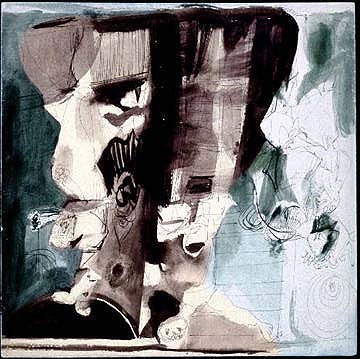
by Bettina L. Knapp
What so impressed Artaud about
the Oriental and especially the Balinese theatre was the importance accorded to
gesture and facial expressions and the relatively unimportant role delegated to
the spoken word. He described the impact of the physical action on stage and its
effect upon man's conscious; the emergence of the latter not only by means of
the spoken word, but also by means of gestures, which should be looked upon as
a kind of hieroglyphic or symbol. Gestures would thus act as transforming agents;
communicating the mysterious and hitherto unrevealed contents of the author's,
director's, and actor's unconscious and conscious intentions, making them visible
on stage in the form of an elevated arm, a lowered finger, etc. Dance, lighting
and music, considered from this point of view are laden with a certain magical
force, empowering them to transform the amorphous into the concrete.
The fact that words are not the essential features in Balinese theatre appealed strongly to Artaud; he who had always had such difficulties formulating ideas by means of them and who described his struggles in this domain so pathetically. Artaud was absolutely convinced that words are just incapable of expressing certain attitudes and feelings, and that these can be revealed only through gestures or sounds, symbolically felt.
"All true feeling is in reality untranslatable. To express it is to betray it. But to translate it is to dissimulate it."
Therefore, objects, music, chanting, costumes, gestures and words, used together are much more effective in bringing about powerful reactions in the spectator than are words used either alone or as primal factors in a spectacle. Imitative harmonies, such as the hissing of serpents or the buzzing of insects, lend a metaphysical and awesome quality to a production.
"It happens that this mannerism, this excessively hieratic style, with its rolling alphabet, its shrieks of splitting stones, noises of branches, noises of the cutting and rolling of wood, compose a sort of animated material murmur in the air, in space, a visual as well as audible whispering. And after an instant the magic identification is made: We know it is we who are speaking."
The impact consequently, of such a group of elements on the viewer is tremendous.
Artaud went still further in formulating his views. All the operative elements in Balinese theatre (music, costumes, objects, words, gestures, etc.), he reasoned, leave no space unutilized. A concrete sculptural quality is, therefore, created on stage which fills up the void about the actor. Not only does such theatrical architecture add to the visual enjoyment of the spectacle, as Artaud saw it, but it captures the theatre's essential qualities: its metaphysical and spiritual aspects.
"There is an absolute in these constructed perspectives, a real physical absolute which the Orientals are capable of envisioning - it is in the loftiness and thoughtful boldness of their goals that these conceptions differ from our European conceptions of theatre, even more than in the sTRANGE perfection of their performances."
By means of a harmonious use of stage elements (gestures, voice, words, etc.) a Balinese theatrical spectacle succeeds in injecting a feeling of metaphysical terror into the heart of the spectator. When a spectator (a "blasphemer") sees a sTRANGE and horrifying wooden form appear before him on stage, he feels he is viewing a manifestation from beyond, when he is actually seeing the image of his own blasphemy (in projection). When Dragons or other inhuman manifestations come on stage, dread has been aroused within the audience by something concrete, not by language which is in itself an abstraction. The theatre, in this way, has become, symbolically speaking, the manifestation of something "inhuman" or "divine".
Artaud sought to create an Occidental drama that would take on these solemn and frightening aspects present in Oriental theatre: where the "inner eye" would become operative. He looked upon everything on stage as symbolic, as a sign behind which lies a mysterious, fabulous, and dangerous reality. Reality, for the Westerner, resides in "appearances, "show", "facade"; for the Oriental and Artaud, true reality resides in the world "within" -which resembles the Westerner's dream world. It was the Oriental's reality, corresponding to the Westerner's unconscious world, that Artaud wished to represent on stage.
In addition to reflecting man's inner world, the theatre, because of its metaphysical and religious nature, must be, a manifestation of cosmic reality. Consequently, author, actor, composer, dancer, musician, director, spectator, objects, color, sound, gesture, movements, rhythms and word in the theatre arena, must be looked upon as differentiations or parts of the cosmic whole. Space, therefore, is seen as, something alive full --- active --- as part of the cosmic flow and not distinct from it.
Furthermore, since the theatre, Artaud felt, should be looked upon as a religious ritual and the prima materia of religions are: he advocated a theatre based on myths.
A myth, it must be recalled, is a dramatic relating of those experiences or a description of those qualities which are deepest within man. Myths are the outcome of original experiences; not always personal, but rather impersonal or transcendental. In ancient times, for example, people believed that flowers, rocks, water, ice --- all of nature's forces --- were inhabited by Gods. Primitive man did not just watch the sun rise and set and accept it as such. He assimilated this external experience which then became an inner one. For instance, he likened the story of the sun's daily journey through the skies to a hero's fate. He did likewise with everything in nature: rain, thunder, harvest, drought. The fascinating and terrifying images man's unconscious produced, as a result of the experiences, took the form of dreams and premonitions and fantasies; they became symbolic expressions of an inner drama which he could only cope with by projecting into nature or the environment These projected dramas or Myths, transcended the individual conscious mind in that they occurred everywhere, in all of mankind. Every culture has its Creation Myth, a God Myth, etc. and these myths, whose origins are in many cases prehistoric, are recorded sooner or later.
"The
theatre must make itself the equal of life --- not an individual life, that individual
aspect of life in which CHARACTERS triumph, but the sort of liberated life which
sweeps away human individuality and in which man is only a reflection. The true
purpose of the theatre is to create Myths, to express life in its immense, universal
aspects, and from that life to extract images in which we find pleasure in discovering
ourselves."
================================
tHE
pHiLOSOPHER'S sTONE Pages
hOME